


Working in a competitive organisation, you’ve no doubt encountered the concept of 'value,' often integrated with agile methodology.

Stay ahead of the curve with the latest agile trends. Learn about new methodologies, tools, & practices that can help improve your team's productivity. (150/150 chars)


Scrum Product Owners, learn how to secure your mobile & web platform with this guide. Covers security requirements, risk assessment, & implementation

By Karl Fischer
The business and technology world is undoubtedly undergoing an incredible journey. There is an avalanche of technology capabilities and opportunities that can seem overwhelming at first, but that wave of innovation is also one that is enabling success.
The traditional lines between "business" and "IT" have at the very least been blurred if not eliminated in organisations adopting the digital revolution. For these companies, IT is a business life-blood and business a heartbeat that drives demand for technology and requirements.
So how does IT become the Business Hero of today?
Having a roadmap (a "GPS" for millennials) to guide one would help, so here are the six advisory steps we utilise at DVT to assist our clients to understand digital and agile transformation context and become heroes to their business.
Step 1: Know where your business wants and needs to go.
Understand the opportunities and how they line up with what your business is trying to achieve.
For the digital (or digital aspirant) business, there are a few typical positions that you can identify and align with to provide the technology focus needed to enable achieving those goals. Consider Gartner's "Journey to Digital Business":

Knowing the goals and objectives of your business, then consider the maturity of your IT function and consequent ability to contribute.

KEY ACTION:
Know your business's key objectives and then align with and measure your IT activities toward achieving those goals. Develop your framework by positioning where IT is today for your business, and where it needs to be to make your business successful.
Step 2: Road trips are better with friends (Collaboration is the new normal)
In most established organisations, the IT function has evolved over time and is probably not identified alongside innovation and agility. If IT in your business is seen as the Innovator, then you are well ahead of the curve. But most departments will need to show a new dimension and practice conscious change management to reposition IT as a key enabler of the business.
A good anecdotal gauge is if there is a distinction between "business projects" and "IT projects". When there isn't, IT has "made it" into being just another key business contributor. Getting there often means bringing in "friends" with specialist skills and experience that can fast-track you into the technologies and processes that are enabling digital initiatives (Think cloud, social, mobile and analytics). More importantly, the nature of the engagement with your new best friends can well be different to consulting engagements of the past with the "experts", providing an expensive opinion as to what needs to be done. Ever had that experience where you were left wondering, "That's interesting, but HOW do we do this?"
At DVT, we look to establish a partnership with our clients that will see them function not just deliver on project objectives but gain the insight, skills and capability that will enable them to take the initiatives forward in the future. When our clients are better off, we've delivered on our partnership commitment. Our extended eco-system of partners with specialist skills ensures we are well positioned to provide a full-fledged solution. Digital is complex and extensive in scope. Bringing the right parties to an initiative, with the right attitude toward a common intent leads to better results.
KEY ACTION:
Find partners with the experience that compliments your team and where collaboration and knowledge transfer are part of the engagement.
Step 3: Get to know the roads (Ask someone who has been there before then review the options)
Leverage expertise both internally and externally to understand your tactical choices. Consider short little "trips" (experiments with the technology or process) that will give you a better idea of learning curves, ease of use and relevance to the key outcomes your business is looking to achieve.
Knowing there is more than one way to achieve an outcome (and continuing to look for options even after you have a favourite) immediately reduces risk about the investment you will recommend. It's important that IT has considered the alternatives and is providing an informed, business savvy opinion.
KEY ACTION:
Initiate "meet-ups" to talk digital and new ideas and open the invitation to both internal and external parties.
Step 4: Listen to the GPS. Guides are useful, but take the shortcuts
Expectations have changed significantly as to what is possible, what IT should be providing, and the speed at which solutions should be delivered. Fortunately, IT and technology have been innovating at a similarly dramatic pace. There is a multitude of technologies, methodologies and collaborations that can help IT shift its performance and rise to the challenge.
The Agile business may adopt a credo of "fail fast, succeed faster" but that's likely to create significant discomfort in the boardroom unless it's explained (and shown to be managed responsibly). Akin to looking for the shortcuts on the map and having the GPS recalculate the path to journey's end, the introduction of new processes, expertise and technologies can radically shorten the transformation of IT into a current and relevant digital business partner. There's no singular path to the outcome, so consider your options and start with small-scale initiatives on which you can build momentum and where success is probable.
KEY ACTION:
Look for short-term, manageable changes that can start to move your function toward the end goal state (effectively making change through bite-sized, right-sized initiatives).
Step 5: Look at the road, not the representation (Plan and then plan for change)
Expect to make changes and adjust your plans. Having a plan is great. Being responsive and prepared for a change in the journey needs to be standard practice (Agile in essence and action). All too often the adoption of Agile is used as the excuse for:
- lack of planning - "Agile is about doing, not planning" – False
- lack of documentation - "Agile doesn't use requirements documentation or value specifications or analysis" – False
- lack of outcomes - "Agile means we change to work on each and every new request" – False
In the context of the transformation of IT functions, management teams need to consciously manage the change being introduced into the function. Changes in methodology can be difficult to achieve if attempted as purely an IT change. Agile is manifestly NOT just an IT change in how projects are run.
As an organisation focused on Agile, both as a service to our clients and as to how we operate, we know that successful implementation of Agile is a journey best led by those who have been down the path (multiple times). It's why we offer Agile Transformation programmes to our clients and follow them ourselves, believing in an evolution driven by a shared Agile philosophy.
KEY ACTION:
Adopt a conscious programme of change management that intends to see the transformation of the organisation to an Agile entity. Note that just because methodologies like SCRUM have typically taken root in IT departments does not mean that everyone in your IT department (and certainly not across your organisation) understands Agile and is supportive of the change. Consider utilising a formal Agile transformation programme that has been implemented through other organisations and customise it accordingly.
Step 6: You don't need a car if you can Uber
There are key technology enablers that must be part of your thinking for enabling agility, speed of delivery and value delivery: Social, Mobile, Analytics and Cloud. Be aware of the platforms and capabilities that these digital enablers have provided and how you can leverage them for lower cost, rapid development (prototype evolutions) that can help quickly prove a business concept with minimal investment in infrastructure. These mediums lend themselves to collaboration with partners and customers which in turn can help you drive innovation and align with market needs.
KEY ACTION:
Look into the use of "multi-speed" IT (adopting different processes, team structures, and technologies to enable different IT supported areas such as "innovation" (what is wanted) versus "operational support" (what is in place). Service partners can then spin up short-term teams with essential skills to enable such initiatives and introduce fresh thinking.
As Dorothy famously said, "We're not in Kansas anymore", the landscape in technology continues to change dramatically and with it brings new dynamics that demand collaboration, innovation and agility to be successful. With IT being at the centre of this tornado, it's both a challenging and incredibly opportune time for leaders in this space.
The six steps discussed in this blog are how we at DVT open the conversation with some of our clients (collaborators) to ensure that investment in IT will secure both short-term and on-going success for their business.
Visualise the journey, choose your "friends" for the trip, and start your engines! Your business teams are already asking "Are we there yet?”
Sources and Recommended Reading
Gartner – Post Event Trip Report – Digital Maturity Benchmark Summary, 2014
Accenture "Driving an ambitious agenda to transform Accenture into a digital enterprise"
HBR "7 questions to ask before your next digital transformation", Barry Libert, Megan Beck, Yoram (Jerry) Wind, July 2016

Discover business agility with Aaron Sanders. Enroll in exclusive training courses at DVT Academy for enhanced skills. Take the next step now!


By Jacqueline Metrowich
People often ask which Scrum Master certification they should do. There are two internationally recognised certifications, and both of them are endorsed by the founders of Scrum and authors of the Scrum Guide, Ken Schwaber and Jeff Sutherland.
There is no right or wrong when choosing between Certified ScrumMaster (CSM) and Professional Scrum Master (PSM). Both certifications are equally good to have on your CV as evidence of your understanding of Scrum, and you would have to weigh up the pros and cons of each and which is most suitable for you. For example: in a two day CSM class you get practical experience, networking opportunities with other Agilists and exposure to an international subject matter expert, whereas the PSM course is a quick, although not necessarily easy, and cost effective way of getting the desired certification.
Here is some information to help you decide:
1. Certified ScrumMaster (CSM) – Scrum Alliance
To be certified you first must take a two-day course taught by a Scrum Alliance authorised trainer. The process to become a Scrum Alliance authorised trainer is lengthy and stringent to ensure a high standard of training and an accurate representation of Scrum and Agile practices and principles is provided. Instructors must verify their knowledge, experience and training ability, and their course content has to be approved as being consistent with Scrum and Agile principles. For this reason, there are not many trainers certified to train CSM, and the course is relatively expensive starting at R12,500 (excl. VAT) in South Africa. However, you can be assured that a course from a Scrum Alliance authorised trainer is the real thing.
Within 90 days of doing the course, attendees must do an online assessment, which is included in the cost of the course. The assessment consists of 35 multiple choice and true or false questions, of which 24 must be answered correctly. It takes about an hour to do and can be completed in more than one sitting. It can also be retaken once at no extra cost. There is a small fee of $25 for subsequent attempts or if done after 90 days of doing the course.
The CSM certification includes a 2-year membership with Scrum Alliance. Both the certification and Scrum Alliance membership require renewal every two years for a $100 fee.
Website - https://www.scrumalliance.org
2. Professional Scrum Master (PSM) – Scrum.org
For the Professional Scrum Master certification, it is not mandatory to take a training course if you feel you already have a high level of knowledge about Scrum from self-study and on the job experience. You can then do the online assessments to certify your knowledge and ability to apply it.
There are three levels of PSM assessments (foundation, intermediate and advanced) that are based on the Scrum Guide, which is freely available, as well as other recommended reading suggested on the Scrum.org website.
Scrum.org provides training as well. However, there are no courses available in South Africa.
The PSM I assessment consists of 80 multiple choice questions (with one or more correct answers) and true or false questions and requires an 85% pass mark. It takes about an hour and, although it is open book, it requires an understanding of the Scrum Guide in-depth to apply the content based on your experience. It is said to be harder to pass than the CSM assessment, and each payment only gives you one chance to take it, after which you have to pay again. There are free open assessments available to test your knowledge beforehand and gauge your chances of passing.
The costs of the assessments currently are:
PSM I: $150
PSM II: $250
PSM III: $500
There is no renewal cost for the PSM certifications.
Whereas you can claim PMI PDUs (Project Management Institute Professional Development Units) for CSM training, you cannot claim any for the PSM assessments.
Both Scrum Alliance and Scrum.org also provide other certifications to further your Scrum knowledge and expertise. (e.g. Certifications for Product Owners, developers and coaches.)
You may have heard of alternative Agile certifications and training and wonder what they offer and how they differ. While CSM and PSM are specific to Scrum, these options cover Agile more generically and tend to be more expensive. The primary ones that are available in South Africa are:
- PMI-ACP: Offered by the Project Management Institute, requires training, experience and passing an exam
- AgilePM: Offered by APMG International, needs training or self-study to pass an exam
- PRINCE2 Agile: Requires training and passing an exam
DVT Academy offers the Scrum Alliance Certified Scrum Master training and certification with international trainers. DVT Academy specialises in Agile training and certification, and also provides the Scrum Alliance Certified Product Owner training, a suite of ICAgile Certified courses, Kanban training as well as locally certified Agile courses. For more information on all of the courses, visit: http://www.dvt.co.za/training


The successful shift to being an Agile organisation isn’t just about training; it’s essential to have a smart approach to people change management.
Have you ever wondered just how far you could take your business with an Agile transformation?
I often get asked this question by clients that have undertaken to transform their businesses with Agile, but while Agile is indeed a transformative process, it’s also far more than most companies realise when they sign on for the ride.
Agile is not just an IT framework. It’s more than just a ‘new way’ of doing projects. In fact, when I speak of Agile, I’m referring to five fundamental and very different aspects of the concept as a whole: people, process, leadership, structure and culture. Before I can answer the question – how far can you go with Agile – let’s first consider these five pillars of Agile in more detail.
People
This is probably the easiest aspect to grasp and simply speaks to how we treat one another and how we view our people and staff as an Agile business. Agile is totally people focused, empowering and liberating, so this pillar is key to the success of an Agile way of working. Agile enables people to be fully engaged, at their best performance and responsive.
Process
Agile is not linear. There are different frameworks and methodologies to choose from, all of which form part of the process we ultimately decide to follow. These frameworks are there as a guide to help us reach our goals as an Agile organisation. The purpose of the various frameworks is to get us into a habit of doing things differently and to be more relevant to the market and responsive to change.
Leadership
Agile defines leadership as the positive, empowering and supporting influence you have on people, and the feedback you receive in return. This only occurs within the context of a relationship. In contrast, active management is focused more on what you can get from your people because you pay them.
Structure
Agile calls for an organisational structure change where people are loosely coupled but tightly aligned, thus able to make lower level decisions while staying consistent in what we are trying to achieve as a team. As long as the vision is shared, it’s up to the team to find a solution and drive the delivery.
Culture
Probably the most important but least understood of all the pillars, culture speaks to factors such as autonomy, ownership, freedom and innovation. A strong, agile culture exists when direction doesn’t need to be given on a daily basis, only guidance since the vision and goals are shared with the team in context. Agile breeds a no-fear culture, where the business through its people isn’t afraid to fail to succeed.
Now that we have a handle on the five pillars that make Agile what it is let’s look at the three components that support every Agile transformation: mastery, purpose and autonomy.
1. Mastery.
You want to enable your staff to master this thing called Agile, what it is, and what it’s not; what it means to your organisation, the governance you need to put in place to steer the course, and ultimately how to navigate your new Agile business. Things like Agile Training, consulting sessions, directions and transparency during the journey are key.
2. Purpose.
There’s a purpose behind every Agile transformation, programme and project - not only at an organisational level but also on a personal and interpersonal one. There’s an overarching purpose – to make the business more successful, or to break into new markets, for example, and also a softer purpose – to make a difference in people’s lives or to make it easier to achieve their career goals. Whatever your purpose, it’s important that people buy into it and that it is common knowledge. I’ve often heard of people who gave of their time or joined organisations for free because they bought into its purpose and what it was trying to achieve, simply to be part of it.
3. Autonomy.
This is self-explanatory – and also self-perpetuating. If you’ve mastered Agile and have a well-defined purpose, you become autonomous based on trust. As a leader, I share the value of appointing people you trust, and trust them to get the job done.
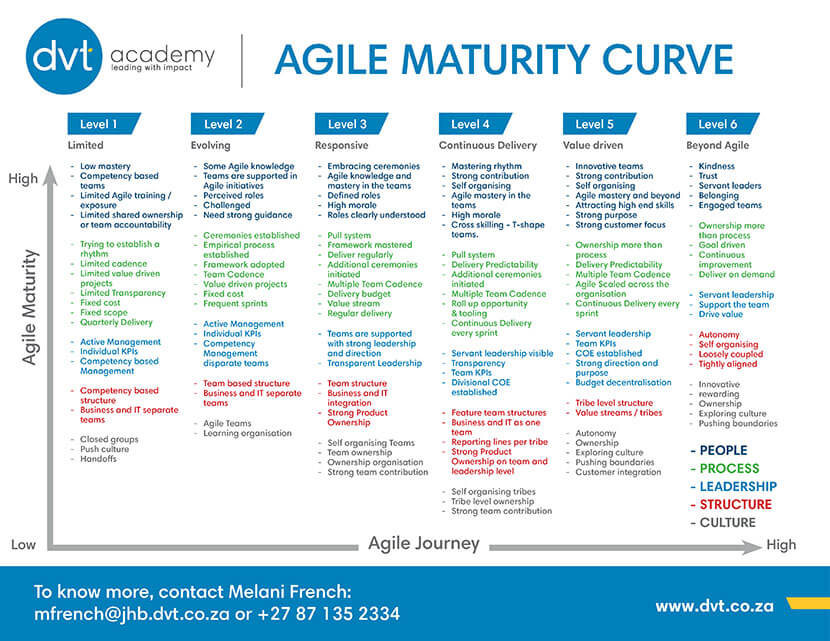
Now that we understand how an Agile transformation works in relation to the five pillars of Agile, we can start to think in terms of Agile maturity. Companies undergoing an Agile transformation are typically graded by where they are on the Agile Maturity Curve. There are six grades along the curve: limited, evolving, responsive, continuous delivery, value-driven and beyond Agile.
All but a small number of companies starting their Agile transformation journey or setting off from a large and cumbersome legacy base find themselves at a level one (limited) grade. Even fewer will ever go beyond Agile, which today is epitomised by the likes of Google, Facebook, Apple, Spotify and other industry pioneers that have redefined what it means to be Agile. Most companies fall somewhere in-between.
Like most things in Agile, there’s no hard and fast rule on what makes one company ‘responsive’ and another ‘value-driven’. There’s an old saying that says ‘you don’t know what you don’t know’. Most Agile ‘sponsors’ are also high-level managers that have been with the organisation for a long time and don’t have a context on what should be done differently to how it’s always been done. Often the company’s people and processes are very mature, but the leadership – in Agile terms – is not. Alternatively, everything else is in place, but the organisational culture is keeping the business anchored.
This is where astute mentorship is key, because Agile maturity isn’t just about expensive training and leadership courses, but rather focused on coaching in the areas that need strengthening or alignment. Looking at the Agile Maturity Curve will give you a better idea of what the end goal looks like and focusing your budget appropriately. Sometimes it is more spent on change management and influencing the culture, as appose to Agile training and coaching.
Surprisingly, most of the change will come with the ‘softer’ aspects of Agile – how you treat people, enable people, lead people. An Agile way of working in an Agile organisation often lies in finding the right level of collaboration and communication. Sending your staff on an Agile framework course won’t teach them how to be Agile. Soft training and Strengths-based training will assist in this area.
Take a longer look at the organisations that have truly gone beyond Agile, and they’ll all put their success down to the ‘softer’ aspects of kindness and trust, a sense of belonging and ownership instead of a process or management focus. It’s very different to the conventional way of thinking, and how we traditionally get people to move in a certain direction, but there’s also no question that it works.
So how far can you take your business with an Agile transformation? Tread softly, and before you know it, you will have a friendly, learning organisation which is engaged in the organisational purpose - operating as high performing teams.
About Melani French
Executive head of DVT business enablement
 Melani heads up DVT's business enablement and Agile transformation practice. She is responsible for the delivery of consulting and training services to clients in the Agile, program management, project management and business analysis space. Having joined DVT as an Agile leader in 2011, Melani's strong technical, delivery and leadership background enables her to assist many organisations to optimally deliver solutions. Her passion is leadership and Agile delivery since these are essential for companies to thrive in a competitive market.
This article was published exclusively on ITWeb on 3 July 2018.
In today’s increasingly competitive business world, we don’t have the luxury to roll out new products and projects in six weeks, let alone six months or a year, as was the case in the past.