
Databricks EMEA CTO: AI is changing company structures, not only productivity
In a recent DVT Insights Webinar, Dael Williamson outlined why the next phase of enterprise AI will depend less on chatbots and productivity gains, and more on data, governance, organisational design and new ways of working.
Artificial intelligence is entering a new phase. While much of the discussion has centred on productivity gains and automation, organisations are beginning to confront a broader challenge: how AI is changing the way work is structured, coordinated and delivered across the enterprise.
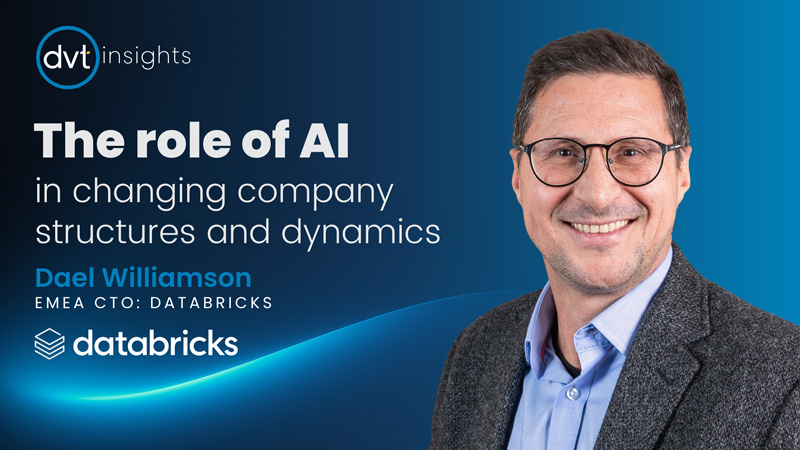
This was the central theme of a recent DVT Insights Webinar, The role of AI in changing company structures and dynamics, presented by Dael Williamson, Chief Technology Officer (EMEA) at Databricks, and hosted by Karl Fischer of DVT. During the session, Williamson shared insights drawn from enterprise AI adoption trends, real-world usage patterns and research into how organisations are adapting to increasingly autonomous forms of AI.
According to Williamson, AI is already delivering measurable value in a growing number of focused use cases, but many organisations remain at an early stage of maturity. While experimentation is widespread, the path to production remains challenging.
Williamson noted that many organisations continue to treat AI as a productivity tool rather than a catalyst for broader organisational change. He argued that the greatest impact may ultimately come from rethinking how work flows through a business, how decisions are made and how teams collaborate with increasingly capable AI systems.
A major theme of the session was the importance of enterprise data. While foundation models are becoming increasingly powerful, Williamson cautioned that models alone cannot understand the context, processes and complexity that make each organisation unique.
“The first problem is models are smart and they do not understand your company,” he said. “They do not know your language. They do not understand how you measure things. They do not understand how your people work. They do not understand how you are organised.”
He added that organisations cannot expect meaningful results from AI if the underlying information it relies upon remains fragmented.
“AI without data is just hallucinations,” he said.
As a result, businesses need to focus not only on AI models, but also on the infrastructure that supports them. During the webinar, Williamson highlighted the growing importance of unified data platforms, governance frameworks, testing, telemetry and orchestration layers that enable AI systems to operate reliably and securely at scale.
He argued that many of today’s business systems were designed for people rather than AI agents. Processes, interfaces and organisational structures that work reasonably well for human users often become barriers when autonomous systems are expected to operate across multiple platforms and data sources.
The discussion also explored how AI is accelerating software development while simultaneously creating new challenges. As code generation becomes easier, traditional bottlenecks are shifting towards testing, validation and quality assurance. Organisations are increasingly being forced to rethink established development practices and operating models.
Williamson suggested that future organisations may look very different from today’s hierarchical structures. While traditional organisational charts are designed around human coordination, he noted that AI agents often operate more effectively in networks, raising important questions about how work, accountability and decision-making will evolve over time.
Another key takeaway was the role of governance. Contrary to perceptions that governance slows innovation, Williamson said effective governance can accelerate adoption when it is embedded into systems from the outset.
“Our empirical data shows us that strong governance that is codified makes your AI go to production 12 times faster on adoption,” he said.
Asked how business and technology leaders can begin preparing for this new environment, Williamson emphasised the importance of hands-on experimentation and continuous learning.
“Anyone who is not playing is not an AI leader,” he said. “You have to play with the stuff.”
He encouraged organisations to draw on lessons from previous technology shifts while remaining open to new approaches. Curiosity, experimentation and a willingness to challenge longstanding assumptions will be essential as businesses navigate the next stage of AI adoption.
Williamson also pointed to South Africa’s history of practical problem-solving and engineering ingenuity as a potential advantage. As organisations explore new AI-driven operating models, he believes local talent is well positioned to build innovative solutions that balance capability with efficiency.
The broader message from the webinar was clear: the next chapter of enterprise AI will not be defined by chatbots alone. Success will depend on how effectively organisations combine data, governance, technology and people to create new ways of working in an increasingly AI-enabled world.
Watch the webinar recording: https://youtu.be/9_oFR-oerio?si=Mu6Uivtl4g6-2NUs.